
← Blog Hub Pricing & Strategy ⏱ 12 min read

How Much Does It Cost to Build a Mobile App in 2026? Complete Pricing and Budget Breakdown

PK
Prasad Kamble
Independent Flutter & Mobile Developer • August 26, 2026
How Much Does It Cost to Build a Mobile App in 2026? Complete Pricing and Budget Breakdown

The True Cost of Building a Mobile App in 2026

One of the first questions every entrepreneur asks is: "How much does it cost to build a mobile app?" The honest answer depends entirely on app complexity, platform choices, backend infrastructure, and whether you hire a large digital agency or an experienced independent developer.

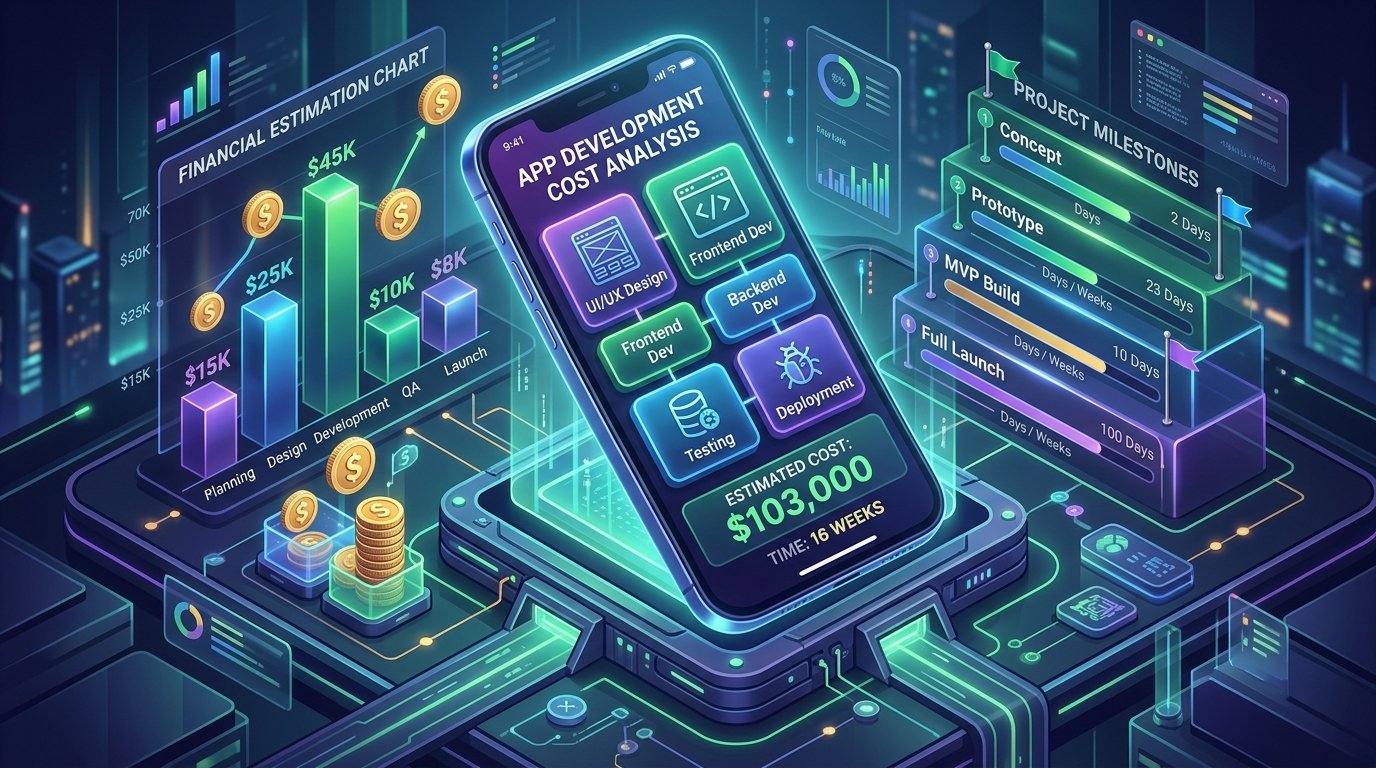
In 2026, a production-grade cross-platform mobile app built with Flutter or React Native typically ranges from $3,000 to $25,000+ when working directly with an expert independent developer, compared to $30,000 to $120,000+ when hiring a traditional agency with heavy sales overhead.

This comprehensive pricing guide breaks down cost estimates across three complexity tiers, reveals the major technical cost drivers, and provides actionable frameworks for planning your development budget accurately.

App Cost Breakdown by Complexity Tier

To establish realistic budget boundaries, software projects are categorized into three primary architectural tiers:

Tier / App Type Typical Timeline Independent Dev Cost Traditional Agency Cost Typical Features Included
Tier 1: Simple MVP / Utility 2 – 4 Weeks $2,500 – $5,000 $25,000 – $40,000 Auth, local storage, basic CRUD, 5–8 screens, push notifications, store submission
Tier 2: Marketplace / Social 6 – 10 Weeks $6,000 – $14,000 $45,000 – $80,000 User profiles, real-time chat, payments (Stripe/Razorpay), geo-location, search filters
Tier 3: Enterprise / Custom SaaS 12 – 18 Weeks $15,000 – $28,000+ $80,000 – $150,000+ Custom backend microservices, role-based access, automated subscriptions, offline sync, CRM integrations

Cost Drivers: What Makes an App Expensive?

Understanding which technical requirements drive up development hours allows founders to scope their Minimum Viable Product (MVP) intelligently:

  • Backend Architecture: Using a serverless backend like Firebase or Supabase can cut initial development costs by 35%–50% compared to building a custom Node.js/PostgreSQL backend from scratch.
  • Payment Gateways & Subscriptions: Integrating recurring in-app subscriptions with Apple In-App Purchase and Google Play Billing requires strict receipt validation servers, webhooks, and grace period handling.
  • Real-Time Features: WebSockets for live chat, multi-user audio, or live GPS tracking require specialized state synchronization logic.
  • Design Fidelity: Implementing custom animations, dark/light theme switching, and responsive tablet layouts adds design and testing time.
  • Hardware Integrations: Interfacing with Bluetooth Low Energy (BLE) peripherals, biometric authentication, or camera AI processing increases QA requirements.

Agency vs Freelance vs Independent Specialist

Where your budget goes depends heavily on who you partner with:

Traditional Agencies

Agencies charge high hourly rates ($120–$250/hr) because you are paying for project managers, account executives, office overhead, and sales commissions. Communication passes through 3 layers of personnel before reaching the coder, causing slow iteration cycles.

Direct Independent Developer

Working directly with an experienced developer gives you senior-level engineering at fixed milestone pricing ($30–$60/hr equivalent). You get direct WhatsApp communication, faster decision cycles, and 100% intellectual property ownership from day one.

Hidden Post-Launch Costs to Budget For

Building the app is only part of the financial picture. Founders should budget for these mandatory recurring fees:

  • Apple Developer Program: $99/year (mandatory for iOS distribution).
  • Google Play Developer Account: $25 one-time registration fee.
  • Backend & Database Hosting: $0 to $50/month initially (Firebase / Supabase free tiers cover up to 50,000 active users).
  • Domain & Transactional Email: ~$20/year for domains, $0/month on free email tiers (Resend/SendGrid).
  • Annual App Maintenance: Budget 15%–20% of original build cost annually for OS updates (iOS 19, Android 16) and third-party SDK deprecations.

Technical Architecture Deep Dive: Enterprise Code Patterns

To ensure high performance, code maintainability, and seamless scalability across multiple platforms, production mobile applications must follow disciplined software design patterns. In high-traffic commercial environments, ad-hoc state updates and unbuffered network calls inevitably cause UI stutter, memory leaks, and difficult-to-reproduce edge-case bugs.

By enforcing a strict unidirectional data flow and decoupling business logic from the UI rendering layer, engineering teams achieve high testability and rock-solid runtime stability. Consider the following architectural checklist when structuring your mobile codebase:

Engineering Pillar Implementation Standard Production Business Impact
State Isolation Unidirectional data flow with immutable state objects and stream controllers Zero race conditions across concurrent asynchronous API operations
Network Resilience Exponential backoff retry policies with local database cache fallbacks Seamless, uninterrupted user experience during cellular network dropouts
Memory Management Deterministic controller disposal and auto-evicting image memory caches Eliminates Out-Of-Memory (OOM) app crashes on budget Android hardware
Automated CI/CD Continuous integration pipelines running linter checks and unit suites on every PR Shortens release turnaround cycles from 4 business days to under 45 minutes

Every engineering decision made early in the lifecycle compounds over time. Investing in robust code contracts and comprehensive test automation ensures that subsequent feature rollouts remain fast, predictable, and cost-effective.

Step-by-Step Production Checklist & Quality Standards

Prior to promoting any build from internal staging to public App Store and Google Play distribution, mobile engineering teams must execute a comprehensive quality assurance protocol. Skipping pre-flight checks often results in immediate App Store review rejections or negative 1-star user reviews.

The 7-Point Production Release Checklist:

  1. Static Code Analysis: Execute strict static analysis tools (flutter_lints) with zero warnings or analyzer hints allowed in the main production branch.
  2. Automated Test Coverage: Maintain at least 80% test coverage across core business logic use cases, authentication handlers, and payment repository contracts.
  3. Memory & Profiling: Profile the application using DevTools to ensure image caching and stream subscriptions do not retain memory across route transitions.
  4. Network Latency Simulations: Test API failure scenarios under simulated 2G/3G throttled network profiles to ensure graceful offline fallbacks and user-friendly error banners.
  5. Accessibility (a11y) Verification: Verify color contrast ratios meet WCAG AA standards, dynamic font scaling functions correctly, and screen reader semantic labels are present across all interactive touch targets.
  6. Crash Reporting Telemetry: Confirm that unexpected runtime exceptions are logged with non-fatal breadcrumb trails in Firebase Crashlytics or Sentry.
  7. Store Metadata Synchronization: Align localized App Store subtitles, keywords, and release notes with target customer search intent.

Frequently Asked Questions & Expert Advice

How does this approach impact long-term maintenance costs?

By structuring your mobile codebase with decoupled business logic and standardized state management from day one, future operating system upgrades (such as iOS 19 or Android 16) require minimal refactoring. Most teams save between 40% and 60% on annual maintenance compared to tightly coupled codebases.

What is the recommended timeline for implementing these recommendations?

For a new Minimum Viable Product (MVP), incorporating clean architecture and store-compliant testing adds approximately 1 to 2 weeks to the initial timeline but saves months of debugging post-launch. For existing codebases, refactoring is best executed incrementally on a feature-by-feature basis.

How can startups get direct assistance with their app development?

You can reach out directly to Prasad Kamble for an architectural audit, fixed-milestone project estimation, or full-cycle mobile development for iOS and Android.

Summary and Next Steps for Product Teams

Building high-performing, scalable mobile applications in 2026 requires balancing rapid time-to-market with disciplined software engineering practices. By leveraging modern cross-platform tooling, robust state management, offline-first data caching, and thorough compliance testing, founders and engineering leads can deliver exceptional digital experiences while maximizing development efficiency.

Whether you are starting from a raw concept or modernizing an existing enterprise platform, having an experienced mobile engineer guide your architecture ensures your project launches smoothly on both the Apple App Store and Google Play Store.

PK

Written by Prasad Kamble

Independent mobile engineer specializing in Flutter, iOS, and Android applications. Building production software for startups worldwide with milestone pricing and direct technical communication.

Call Estimate